September 14, 2026 · 5 min read
Loss to lease, explained with a worked example
What loss to lease measures, how to calculate it in dollars and as a percentage, and how to use it without misreading it. Includes a worked example.
Loss to lease is one of the most useful and most misunderstood numbers in residential property management. It tells you how far the rents your residents are paying today sit below what the same homes would rent for if you leased them today. It is a measure of rent you are not collecting because leases were signed at older prices, not a measure of money you have lost.
The formula in words
For each occupied unit, take the current market rent for that unit and subtract the rent in the resident's lease. Add up the differences across the property. That total, usually expressed per month, is your loss to lease in dollars.
To express it as a percentage, divide loss to lease by gross potential rent, which is the sum of market rent for every unit at the property, occupied or not. Some owners divide by market rent for occupied units only. Either is fine as long as you state which you use and keep it consistent.
When a lease is above current market rent, the difference is negative. This is often called gain to lease. Most reports net gains and losses together, but it is worth looking at them separately, because a property with large gains on some units and large losses on others has a different problem from one where every unit is slightly under market.
A worked example
Imagine a 100-unit property where every unit is the same two-bedroom floor plan. You estimate current market rent at $1,500 per month. Ninety-five units are occupied and five are vacant.
- Gross potential rent: 100 units x $1,500 = $150,000 per month.
- Of the 95 occupied units, 40 were leased recently at $1,500. Loss to lease on those: $0.
- 35 units have leases at $1,450. Loss to lease: 35 x $50 = $1,750.
- 20 units have older leases at $1,400. Loss to lease: 20 x $100 = $2,000.
- Total loss to lease: $1,750 + $2,000 = $3,750 per month, or $45,000 over a year if nothing changed.
- As a percentage of gross potential rent: $3,750 / $150,000 = 2.5%.
Note what the example does not include. The five vacant units are vacancy loss, a separate line. Any concessions you gave are another separate line. Keeping these apart is the point: loss to lease tells you about pricing on existing leases, vacancy tells you about occupancy, and concessions tell you about what it took to sign.
The hard part: what is "market rent"?
The formula is simple. The input is not. Market rent can be set from your current asking rents, from recent signed leases at the property, from comparable properties nearby, or from a pricing tool. Each gives a different answer, and a generous market rent estimate will make loss to lease look larger than it really is.
- Use one definition per property and write it down.
- Prefer recent signed leases over asking rents where you have enough of them.
- Set market rent by unit type, and adjust for features that residents actually pay more for, such as a renovated kitchen or a top floor.
- Review the estimates monthly. Stale market rents make the number meaningless.
How to use loss to lease
Loss to lease is most useful for planning renewals and for spotting where your pricing drifts. A few practical uses:
- Sort occupied units by loss to lease and review the largest gaps first when renewal offers go out.
- Compare loss to lease between unit types. If one type carries most of it, your market rent for that type may be off, or those residents may have signed during a slow season.
- Track it monthly. A steady rise means market rents are moving faster than your leases, which is normal in a rising market but should be planned for.
- Weigh it against turnover. Closing the gap fully on renewal may push residents to leave, and a vacant unit, turn costs and the time to re-lease can cost more than the increase you were after.
Check the rules before you act on it
Many cities and states limit how much and how often rent can rise, require specific notice periods, or regulate renewal terms. Loss to lease tells you where the gap is; local law decides how much of it you can close and when. Before you set renewal increases, check the rules that apply to each property. This is general information, not legal advice.
A note on StrivBridge
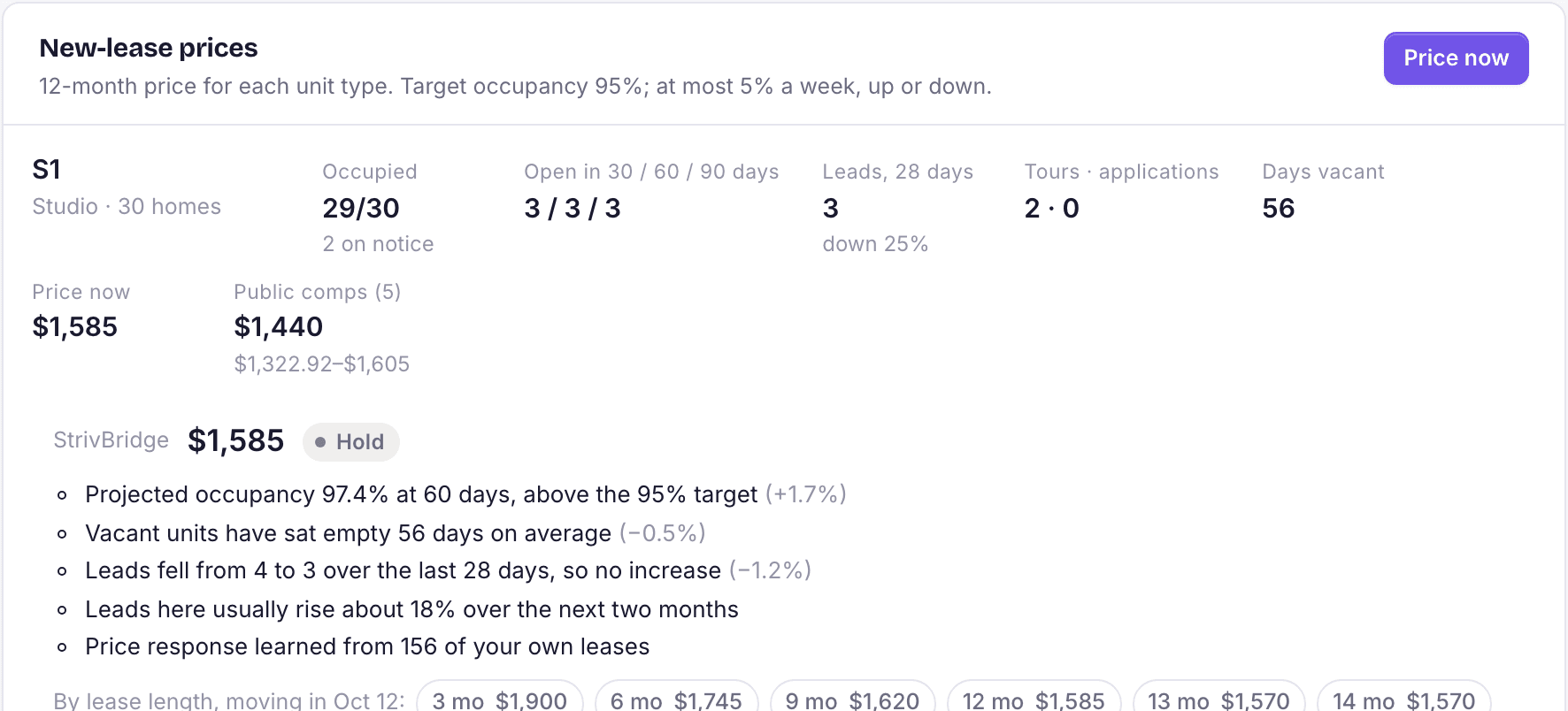
StrivBridge suggests rents by unit type from your own leasing data, shows current rents against the market, and tracks upcoming lease expirations, so you can plan renewal offers with the numbers in front of you. It is included in the $5 per unit per month price, with a 30-day free trial.